
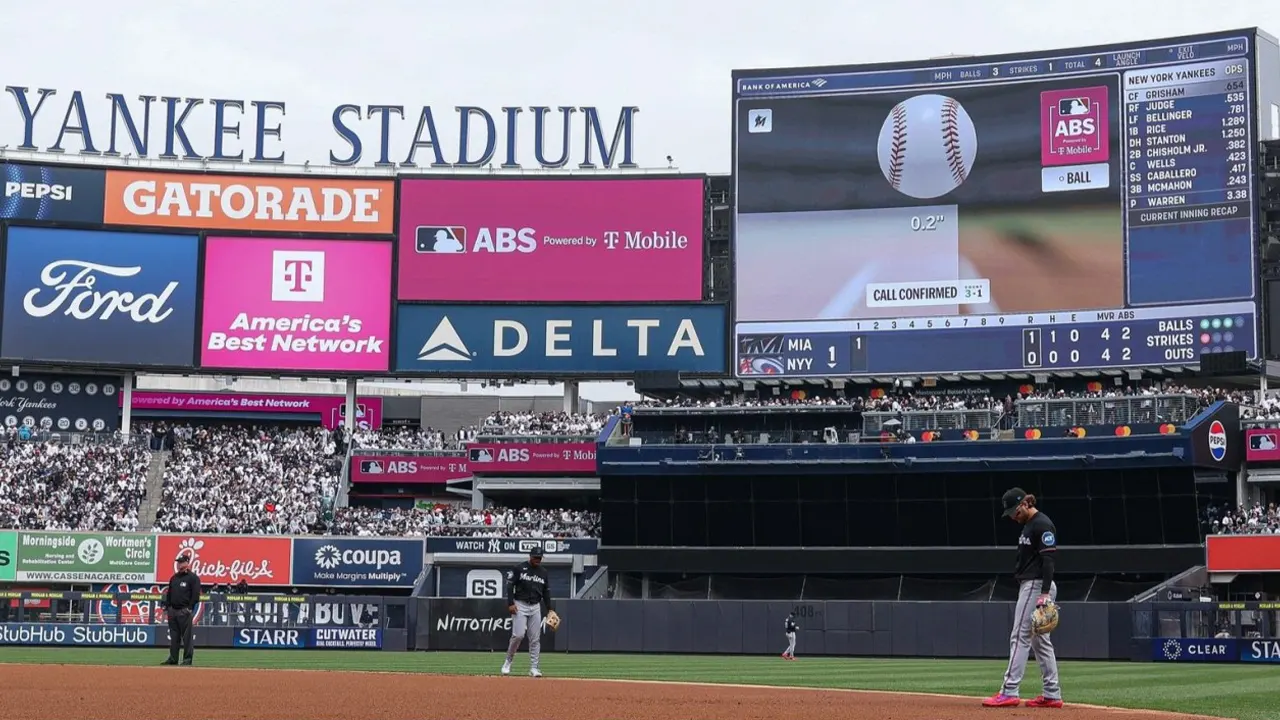
April 15, 2026 – A first-pitch fastball that looks outside but is overturned to flip the count to 0-1. A borderline 2-2 curveball that is called a strike but overturned to keep the at-bat alive. A full-count fastball for a called third strike that freezes the hitter, who challenges … only to see that the pitch did indeed clip the zone.
Sure, greater accuracy was the goal, but Major League Baseball (MLB)’s new Automated Ball-Strike Challenge System (ABS) powered by T-Mobile also brings added levels of both strategy and fan excitement to the 2026 season. While ABS has been in play at the minor-league level, MLB players are learning to balance the confidence to challenging with the patience of saving challenges for key moments, adding plenty of intrigue to the system’s first three weeks at the Major League level.
“What actually surprised me is how popular this is with fans,” MLB Commissioner Rob Manfred said. “When the challenge happens, everybody’s kind of glued to the jumbotron. It’s amazing. … It’s a form of fan engagement.”
Many rule changes enacted by Major League Baseball since 2023 — including the addition of the pitch clock, a ban on the shift, and limits to pickoffs and mound visits — have substantially shortened the time of an average game. The first three weeks of MLB games with ABS are averaging 2 hours and 42 minutes — up just four minutes from the full-season average in 2025 and up by six minutes from 2024. Manfred said last week on The Dan Patrick Show: “That’s a price I’m prepared to pay,” acknowledging the trade-off of gaining accuracy — from ABS and ball-in-play challenges — in return for a few extra minutes of game time.
The trade-off is working for fans, too, as MLB attendance is up 4.2% through Sunday, a big gain over the 0.09% attendance increase for the full 2025 season. If the 2026 attendance totals continue to outpace last season’s, MLB attendance would clinch a fourth consecutive season with an increase in annual attendance, which it had not done in nearly two decades (2004-07). And ABS is not turning them away, by any means. Because the visualizations of challenged pitches — and their subsequent ball/strike results — are shown on the stadium video boards, fans are seeing exactly what goes into every result … and react accordingly.
The system will undoubtedly pay dividends for players on the extreme ends of the height spectrums, as umpires have misjudged their strike zones; for instance, the New York Yankees’ 6-foot-7 Aaron Judge and the Los Angeles Dodgers’ 5-foot-9 Mookie Betts each had 638 strikes called against them on pitches out of the zone from 2017 to 2025, with 368 of Judge’s incorrect called strikes coming below the zone. Thanks to ABS, he — and his fellow players league-wide — will now have the opportunity to challenge those pitches and turn counts in their favor.
Judge did just that in the Yankees’ second game of the season on March 27 against the San Francisco Giants: After a 1-0 slider initially called a strike to even the count at 1-1, Judge tapped his helmet to challenge. When ABS showed that the pitch was 0.1 inches below the zone and instead a ball, the call was overturned and the count shifted in his favor to 2-0. Five pitches later, Judge sent a fastball over the left-field wall at Oracle Park for his first hit of the season.
“It’s a new part of the game, but you’ve got to get used to it,” Judge said after the game. “I’m not going to try to sit here and challenge every one I think is close. But if it’s a big spot, where I think I’ve got a chance to flip the count, I’m going to do it.”
The count of every at-bat is crucial for Judge and hitters around the league, so every pitch — and the accuracy of every call — matters much more. Last season, the average OPS was 305 points higher (.974 vs. 669) in a 2-0 count than a 1-1 count, and 428 points higher (1.373 vs. .945) for Judge himself.
Not every pitch will be called correctly, even by the best umpires. But the ABS system necessitates the skill of in-the-moment pitch interpretation by the catcher, hitter, pitcher … and, of course, the umpire. “That seems like the whole point of the system,” Texas Rangers Baseball Club assistant pitching coach Dave Bush toldThe Athletic. “Not to get every single borderline call right all game, but to have a way for high-leverage, impactful pitches to be called correctly.” Boston Red Sox manager Alex Cora added: “My whole career there was a lot of screaming and complaining about the calls we didn’t agree with. When you have the challenges, it’s very quiet.”
Through April 14, the Red Sox have been very quiet with their challenges as well, as only the Washington Nationals (eight) have challenged less than the Red Sox (nine), according to ABS analytics platform TaptoChallenge. The Minnesota Twins (59), Miami Marlins and loanDepot park (48) and Colorado Rockies (48) lead the league in challenges issued, while the Cincinnati Reds (70.4%, 27 challenges), New York Mets (64.3%, 28), and San Diego Padres (63.6%, 33) have been the most accurate with overturning pitches through challenges. The league average is roughly 34.5 challenges, with teams successfully overturning just over half (53.8%) of pitches.
The Stars are proud to see Major League Baseball evolving toward a more exciting product for fans, players and coaches alike, and we are eager to add our name to the list of teams taking part in this latest innovation
–Written byJuan Jose Rodriguez